

Black Friday for Fashion Brands trying to Break the Discount Habit

Black Friday lands on 27th November this year. If you’re a fashion marketer, the pressure to go big on discounts has more than likely already started. But the front-running brands this year won’t necessarily be the ones with the biggest percentage off. If shoppers trust you and are already loyal to you, you’re starting the race 10 steps ahead.
That trust isn’t built over a weekend. It’s built in the weeks and months before.
To help you understand how to break the discount habit and lead with strong, trust-building campaigns for Black Friday Cyber Monday, we’ve looked at what Patagonia, REI, and Vivobarefoot do, instead of shouting about price, and how you can borrow their thinking for your own peak plans.
Why is the discount habit so hard to break?
Discounting works in the short term. That’s exactly what makes it so hard to stop. Each year the offer has to be a little bigger to cut through, and every pound off comes straight out of your margin. The longer-term cost is harder to spot. When customers know a sale is always around the corner, the full-price weeks leading up to it feel like an expensive option.
And a relationship built on discounts is only as strong as your next offer. The moment a competitor goes deeper, that loyalty goes with it.
Why trust matters more than ever this Black Friday
Shoppers are thinking harder about where their money goes. They’re building shopping lists way ahead of big discount periods, and they’re doing their research long in advance. So when they do spend, they’re turning to the brands they know will get it right.
For fashion brands, that means the decision is made before Black Friday even starts. If someone already trusts your quality and knows your sizing works for them, your offer becomes a gentle nudge rather than the whole argument.
The Vinted effect
There’s another reason why a discount alone isn’t enough anymore. Shoppers have cheaper options all year round.
Data from SpendMapper, shared with Retail Week, suggested Vinted had 17 million UK customers in 2025, with Next and Primark the only fashion brands ahead of it. Across its markets, members traded €10.8bn in goods last year, up 47%, as more people switched to second hand.
And it’s growth is not slowing down. Monthly visits to Vinted more than doubled in two years, from around 19 million in September 2024 to nearly 48 million in September 2026.
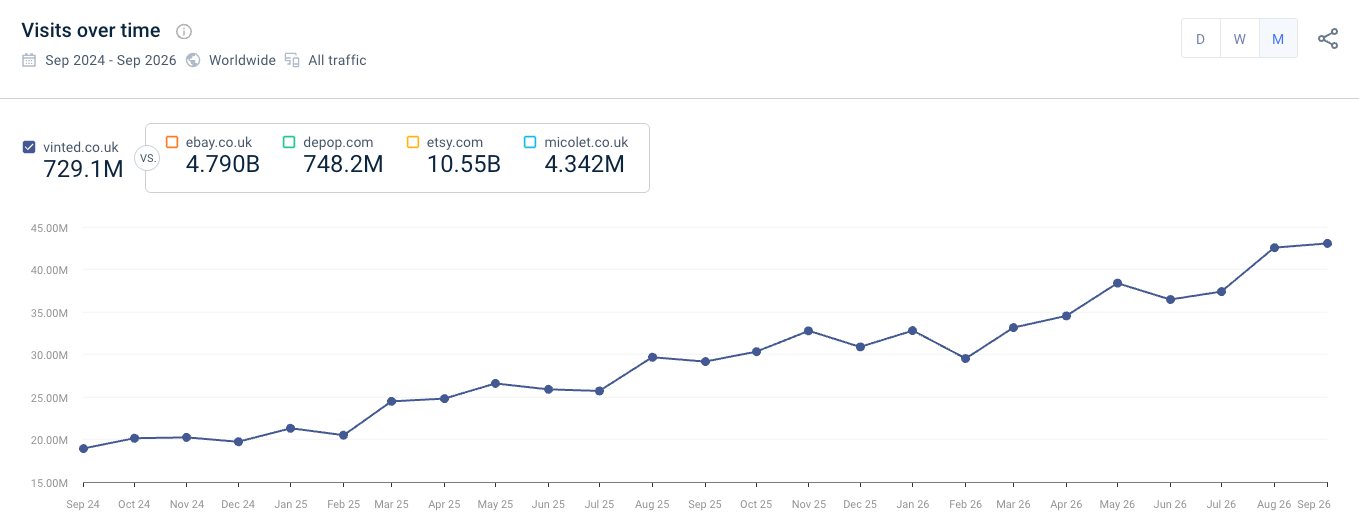
When someone can pick up your last-season (and sometimes even new-season) styles for a fraction of the price, 20% off new stock isn’t such a compelling reason to choose you. Trust, however, is. It’s an opportunity as much as a threat, though. As Vivobarefoot shows later in this article, second-hand can work for your brand rather than against it.
Patagonia: “Don’t buy this jacket”
Patagonia has long been the brand that tells customers to buy less. In the run-up to Christmas, it took that further than most would dare, with an entire campaign built around four words that would make your MD shudder: “Don’t buy this jacket”.
It wasn’t clickbait. The campaign tied into Patagonia’s Common Threads Initiative, which asked people to buy less, repair more, and recycle what they no longer needed. Instead of putting customers off, it made them trust the brand more. And sales followed anyway.
It worked because it was a very on-brand move for them. Patagonia had spent years living its values so customers believed the message.
The lesson here isn’t about telling people not to shop. It’s about building a trust and brand voice that can do more over time than a discount code ever could live up to.
REI: #OptOutside
REI sells outdoor clothing and gear to people who love being outside. And since 2015, it has paid employees to take Black Friday off and encouraged customers to join them outdoors.
What started as a bold campaign has grown into a community, with local events and useful content that keep people connected to REI all year round.
That’s what’s really clever: it’s become a loyalty engine in its own right, built in the quieter weeks of REI’s calendar and paying off long after November.
Vivobarefoot: Make second-hand part of your story
Not every brand can - or should - skip Black Friday entirely. Vivobarefoot shows a middle ground. Alongside new shoes, it buys back and resells pre-loved pairs, and encourages customers to do the same. If shoppers are going to buy second-hand anyway, why shouldn’t it be from you?
Finisterre do something similar with their Repair Programme and Wetsuit Recycling Scheme, showing customers how to be more sustainable rather than just telling them.
For a fashion brand, that’s a pretty compelling story to lead you into Black Friday. A trade-in, repair offer, or resale drop gives people a reason to engage with you that has nothing to do with how much you’ve knocked off the original price, and keeps the relationship with your brand rather than the marketplace.
How to build trust before Black Friday arrives
You don’t need to go full REI to make progress. Here’s where we suggest you can start:
- Show up before you sell. Use the run-up for fit guides or the story behind a collection, rather than just countdown timers to your “biggest discount yet”.
- Reward your best customer first. Early access for your email and SMS list builds loyalty without training everyone else to wait.
- Be selective with offers. Put discounts behind the products where margin can take it.
- Give your offer a reason. A trade-in, repair service or charity tie-in gives you something to say beyond the percentage.
- Check what your ads lead with. If every paid search and social ad opens with a percentage, that’s what you’re teaching shoppers to look for.
- Plan for Jan. Think about what brings Black Friday shoppers back at full price once the sale is over.
Our take
Black Friday is always noisy, no matter what you do. Being louder isn’t the only way through it, though. A few years ago, a client of ours chose not to partake in Black Friday at all. They ran their own annual discount day in October instead. It was one day, on a date they picked, backed by a price promise so shoppers knew they wouldn’t find it cheaper a few weeks later.
Because they weren’t bidding against every other retailer in November, they paid a fraction of the usual CPCs. Over time, their customers learned to wait for that day, meaning the brand was able to drive behaviour and traffic on their own terms. They weren’t reacting to the usual retail calendar - they were setting it.
The brands we’ve featured in this article didn’t try to be the loudest about price. They earned people’s trust long before November, and that’s a habit you should start sooner rather than later. If you get it right, next year your customers will buy when you decide to run a sale, whatever everyone else is doing.
Want some extra insights on how to spur on your BFCM strategies? Our Peak Performance Playbook (say that three times fast…) has got you covered. From paid search to paid social, and everything in between. Download your copy today.

